Fazila Qazi’s First Visit to Dr. Amna’s Clinic Changed That
- Dr Amna's Clinic
- Blog
- Fazila Qazi’s First Visit to Dr. Amna’s Clinic Changed That
"I've Never Had Anything Done" — Fazila Qazi's First Visit to Dr. Amna's Clinic Changed That
-
Dr Amna Clinic
- 4 min read
- July 29, 2026
When one of Pakistan’s most beloved television actresses walks through your clinic doors, it’s a moment worth remembering. But what made Fazila Qazi’s visit to Dr. Amna Usman’s clinic truly special wasn’t the star power she brought with her — it was her honesty. A woman who had never had a facial, never used concealer, and spent decades under harsh studio lighting finally sat down for a real conversation about her skin. And what followed was one of the most genuine, educational consultations we’ve had on record.
A Familiar Face, An Unfamiliar Experience
Fazila came in with two concerns: mild pigmentation that she’d been masking under makeup, and a slight fullness under her chin that she wanted to understand better. By her own admission, she had researched carefully before coming — she wanted a clinic where the advice would be clinical and honest, not commercial.
She found exactly that.
“I agree that there’s a commercial side to aesthetics everywhere,” she acknowledged during the consultation. “But I wanted to go somewhere where the approach felt responsible.”
Dr. Amna’s response set the tone for everything that followed: “We’re not here to sell our procedures. People come to us trusting us — from Gujranwala, from Balochistan, from Sindh. When someone travels that far to see you, you feel the responsibility even more.”
The Double Chin Question: What HIFU Can and Can’t Do
Fazila had heard about HIFU (High Intensity Focused Ultrasound) from multiple sources and was curious whether it could address the fullness under her chin. Dr. Amna gave her an answer most clinics wouldn’t: it depends, and in many cases, it’s being recommended when it simply shouldn’t be.
“The treatment is not indicated for every client. If it’s not the right fit, failure is almost guaranteed,” Dr. Amna explained. “And a lot of the machines being used in commercial beauty centres right now are substandard equipment — the results won’t come.”
She walked Fazila through the science. HIFU melts fat using focused ultrasound energy — but when fat is removed, excess skin is left behind. HIFU can tighten skin to a degree, but it cannot resolve significant sagging on its own. Done incorrectly or unnecessarily, it can actually destroy the good fat that anchors your skin to your face, causing it to sag prematurely. Patients then turn to fillers to restore lost volume — an entirely avoidable cycle.
For Fazila specifically, Dr. Amna’s assessment was direct: the fat deposit was minimal, meaning HIFU alone would be sufficient without any additional lipolytic injections. A clean, proportionate solution — nothing more, nothing less.
“No single treatment is going to be sufficient for every indication,” Dr. Amna summarised. “The follow-up steps matter. You work through them and then you get the picture you have in mind.”

Pigmentation in Pakistani Skin: The Honest Breakdown
The second and more pressing concern for Fazila was her pigmentation — something she’d been living with quietly for years, covering it with makeup rather than treating it. After decades under studio lighting, her skin had developed a pattern familiar to many women in the entertainment industry: surface pigmentation from light exposure, and deeper discolouration consistent with melasma.
Dr. Amna explained the distinction clearly. Surface pigmentation — solar lentigines caused by sun and artificial light — sits close to the skin’s surface and responds well to laser treatments like Q-Switch and topical actives. Melasma, the deeper pigmentation that appears as brown or grey patches, is a different story entirely. Topical creams simply cannot penetrate deep enough to address it meaningfully on their own.
“Pigmentation is treatable,” Dr. Amna reassured her. “It takes effort and consistency, but we understand it much better now than we did even a decade ago.”
Her treatment recommendation for Fazila: Sylfirm X microneedling RF for the melasma — a treatment that reaches beyond the penetration depth of any cream, breaks down pigment at the source, and triggers the skin’s natural renewal process. For the surface pigmentation, Q-Switch laser combined with targeted topicals.
What she explicitly ruled out: chemical peels. For Pakistani skin types with active melasma, chemical peels carry a real risk of making pigmentation significantly worse, not better. It’s a common mistake made in beauty salons and commercial aesthetic centres across the country, and one worth knowing before you book anywhere.
Sunscreen, Vitamin C & the Supplements Conversation
Fazila mentioned she had tried sunscreen previously but developed a reaction and largely stopped using it. This is one of the most common stories Dr. Amna hears — and her response is always the same.
“That doesn’t mean you stop sunscreen. It means you find the right one. It’s not about the price tag — it’s about the ingredients that suit your skin.”
For someone with pigmentation, sun protection isn’t optional. It is the foundation everything else is built on. The team at the clinic prescribed a non-comedogenic sunscreen suited to Fazila’s skin type, along with topical Vitamin C — which Dr. Amna rates highly for melanin suppression and overall skin health — and a mild brightening serum to use alongside her treatment plan.
On the topic of oral collagen supplements, Dr. Amna was refreshingly candid: she’s not yet fully convinced by the evidence. The glow many people report from collagen supplements is more likely coming from the added Vitamin C and glutathione in the formulation than from the collagen itself. Vitamin C orally and topically, she confirms, is genuinely excellent. Magnesium, too. But collagen as a standalone supplement still needs more convincing data.
A First Timer’s Experience
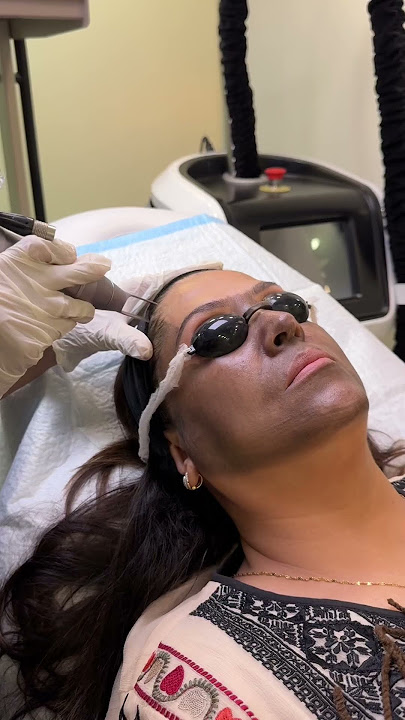
After the consultation, Fazila agreed to move forward with a carbon peel — a laser toning treatment chosen specifically because it’s gentle, has no downtime, and offers a good introduction for someone who had never had anything done before.
Her reaction afterwards was the kind that stays with you: “I didn’t feel as much pain as I was afraid of. I hope it does what I came here for.”
Dr. Amna kept the session intentionally conservative — a first experience designed to build trust, not overwhelm.
The Takeaway
Fazila Qazi came in as a self-described skeptic — someone who had spent a lifetime avoiding aesthetic treatments and had done her research before trusting anyone with her skin. She left with a clear treatment plan, the right products in hand, and an experience that matched exactly what she had hoped for: honest, clinical, and completely without pressure.
That’s what every consultation at Dr. Amna’s clinics is designed to feel like — whether you’re a household name or walking through our doors for the very first time.
Ready to start your own skin journey? Visit any of our clinics across Rawalpindi and Islamabad, or book an online consultation through Global Dr. Amna — available to patients worldwide.
Dr. Amna Usman Aesthetic Clinics | Multiple locations across the twin cities